
Reviewed personally by Dr. Sunkara · Written for Stereotactic Radiosurgery in Hyderabad · Updated September 2026
Quick Answer
Stereotactic radiosurgery in Hyderabad treats brain tumors, AVMs, and trigeminal neuralgia using precisely focused radiation beams instead of a scalpel. There's no incision and no cutting: Dr. Sunkara uses Gamma Knife to deliver a concentrated dose to the exact lesion, often in a single session, sparing the surrounding healthy brain tissue.

Dr. Raveesh Sunkara offers stereotactic radiosurgery in Hyderabad for tumors and vascular lesions that are small, deep, or sit close to structures open surgery would put at risk. It's often the option once an MRI has mapped the lesion precisely enough to target it.
Not every problem needs a surgery, and radiosurgery shows why. One recent patient had a small acoustic neuroma treated with Gamma Knife instead of open surgery near the hearing and balance nerve. For many small lesions like this, a focused dose is the better option, and most people go home the same day.
Stereotactic radiosurgery gets considered for lesions that are small, well-defined, and either hard to reach or risky to remove through open surgery.
01
A high-resolution MRI or CT maps the lesion in three dimensions, with DSA sometimes advised for AVMs. In a few cases, a lightweight frame or custom mask is made to keep your head perfectly still during treatment.
02
Focused radiation beams converge on the lesion from multiple angles while healthy tissue nearby gets only a fraction of the dose. You're awake, and it isn't painful.
03
Most patients leave the same day or the next morning, with no incision to heal and few restrictions beyond a day or two of rest.
01
There's no incision to heal, so most people are back to light activity within a day or two, sometimes with mild fatigue or scalp tenderness.
02
Many lesions need just one session. Larger or irregularly shaped ones are sometimes split into two to five sessions to protect nearby healthy tissue.
03
Unlike surgery, radiosurgery doesn't remove the lesion on the spot. Tumors typically shrink and AVMs typically close over weeks to months, not days.
04
Repeat MRI or CT scans at set intervals track how the lesion is responding, since that response, not how you feel, confirms the treatment worked.
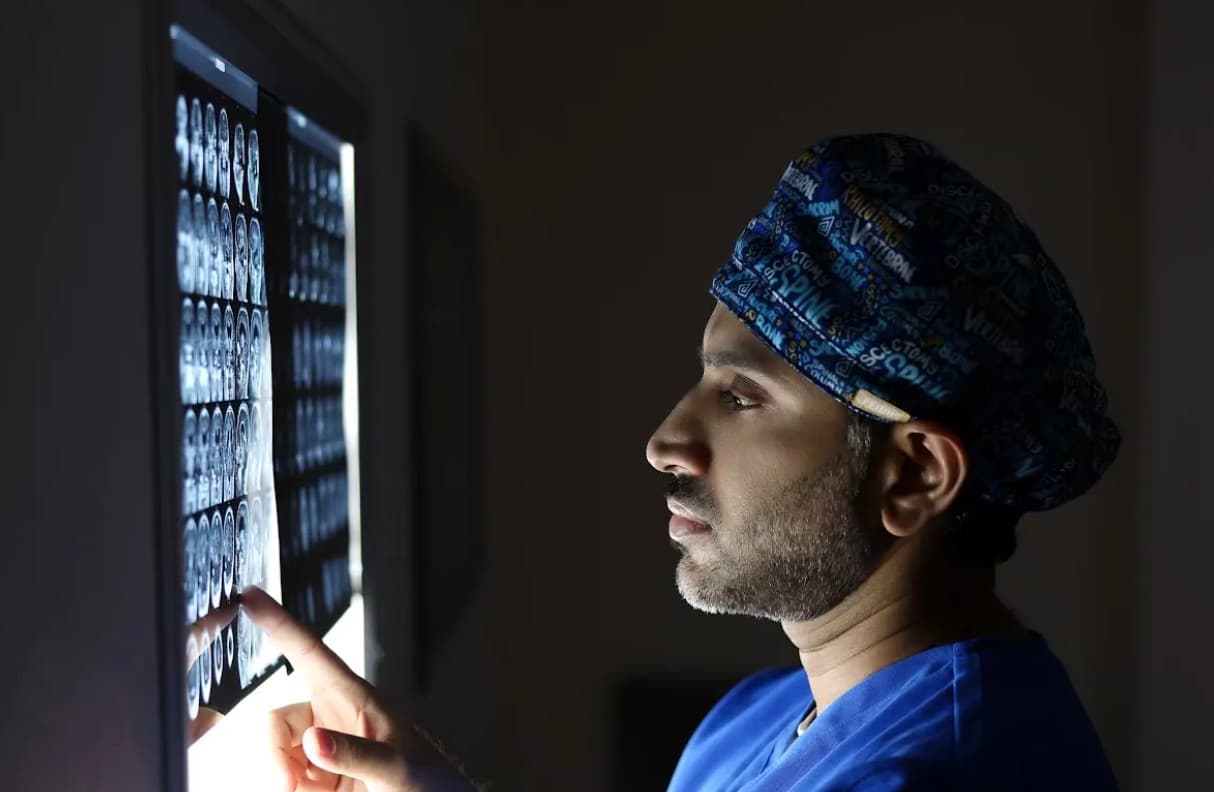
Outcomes for stereotactic radiosurgery vary by lesion type, size, and location, not one blended number.
What happens if a lesion doesn't respond? A small number keep growing or bleeding despite treatment and need another approach.
Stereotactic radiosurgery is generally well tolerated, and most patients are surprised by how uneventful the day feels. Like any radiation treatment, it carries some risks.
Possible Risks & Side Effects
Stereotactic radiosurgery is a non-surgical treatment that uses precisely focused radiation beams to treat a lesion without an incision. It's typically completed in one to five sessions, depending on the lesion's size and shape.
Book a consultation with Dr. Sunkara to see if radiosurgery fits your case, or get a second opinion on a plan you've already been given.

Written & reviewed by Dr. Raveesh Sunkara, Senior Consultant Neurosurgeon & Spine Surgeon · Last updated September 2026 · Next review due March 2027