
Reviewed personally by Dr. Sunkara · Written for Trigeminal Neuralgia · Updated September 2026
Quick Answer
Trigeminal neuralgia is a chronic pain condition affecting the trigeminal nerve, the nerve that carries sensation from your face to your brain. It causes sudden, electric jolts of pain on one side of the face, often set off by something as light as a breeze over the face or brushing your teeth. Episodes last seconds but can repeat dozens of times a day.
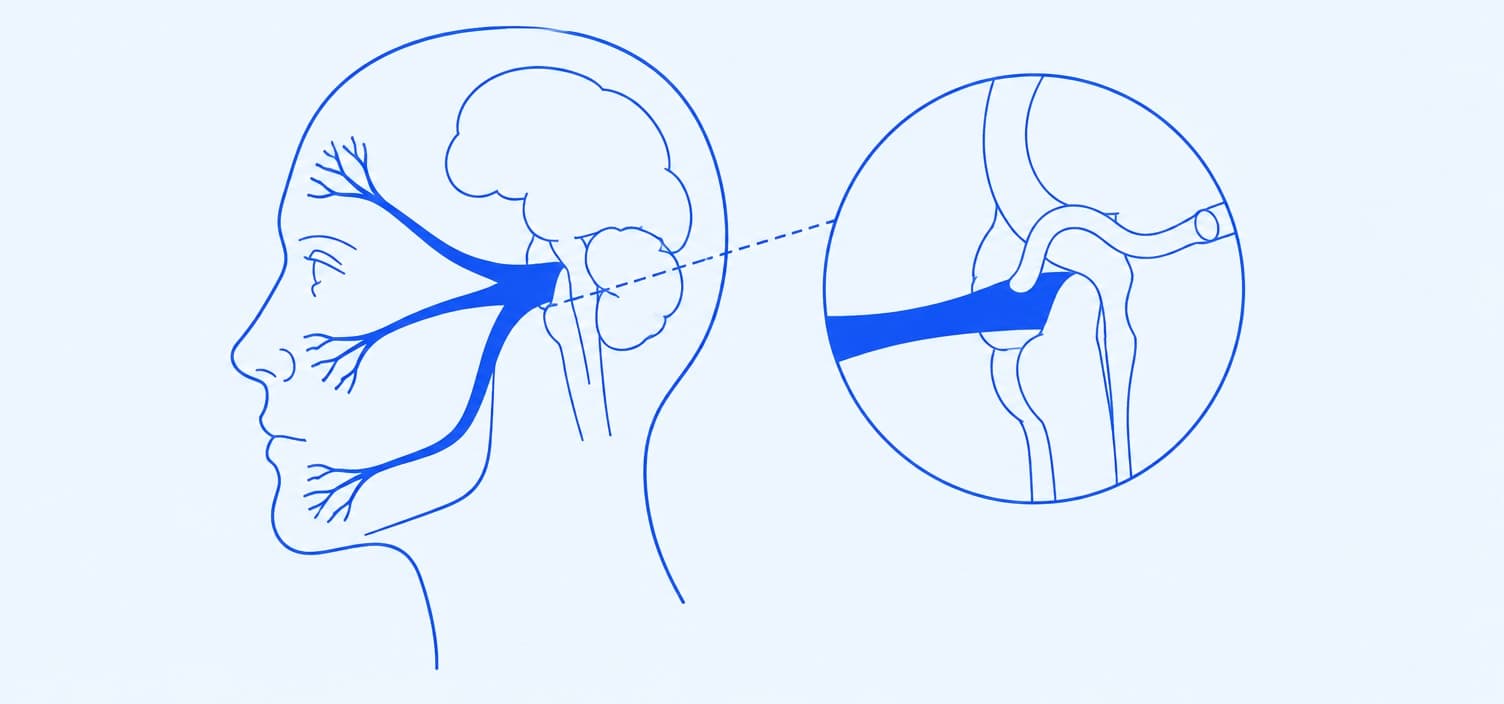
Here's what most people don't expect: the problem usually isn't in the face at all. A blood vessel typically presses against the nerve near where it leaves the brainstem, wearing away the protective coating around its fibers. Many patients think it's a dental problem, since the pain often centers near the jaw or teeth, only to learn on MRI that a blood vessel is the real cause. Some have already had a tooth pulled out that never needed to go.
Trigeminal neuralgia is one specific, well-defined cause of facial pain, not the whole picture. Most facial pain is duller, more constant, and traced to a sinus, tooth, or jaw joint problem instead. The sudden, electric, touch-triggered pattern is what tells the two apart.
Your MRI report or clinic letter will often use one of these terms. Some describe the cause, others the pain pattern. Both shape which treatment makes the most sense.
Trigeminal neuralgia pain feels alarming, especially the first time it strikes. Most episodes settle once the right medication is started, and pain intensity alone rarely signals danger. What matters more is whether new symptoms appear alongside the facial pain.
Seek Immediate Care If You Also Have:
01
Dr. Sunkara starts by mapping exactly where the pain sits, how long each episode lasts, and what sets it off, since that pattern alone often points straight to the diagnosis.
02
A focused check of facial sensation, reflexes and jaw strength rules out other causes of facial pain. It also looks for signs of a secondary cause, such as MS.
03
An MRI is ordered to look for the blood vessel pressing on the nerve, or to rule out a tumor or MS as the underlying cause, since each cause needs a different treatment path.
Wondering how far treatment might need to go? For most people, not very far: medication alone controls the pain, and surgery only enters the picture once that stops working.
Anti-seizure drugs like carbamazepine are usually the first step and work well for most people, especially early after diagnosis.
A heated probe creates a controlled lesion on the nerve to interrupt pain signals, done through the skin without an open incision.
See How It Works →Often cited as the gold standard approach, it's a minimally invasive procedure that repositions the blood vessel pressing on the nerve, addressing the root cause rather than just blocking the pain signal.
A single session of precisely focused radiation interrupts the pain signal without any incision, often for patients who can't have open surgery.
See How It Works →Not always. For many people it's managed rather than cured outright, which surprises those expecting a definitive fix. Medication controls most cases well. When it doesn't, procedures like MVD offer the closest thing to lasting relief, though pain can still return years later.
A few practical habits make flare-ups less frequent and easier to manage day to day.


TRACK YOUR TRIGGERS
Noting which activities set off pain, cold air, chewing, brushing, helps you and your doctor adjust medication timing and daily habits.
SOFT DIET DURING FLARES
Softer foods and lukewarm drinks reduce chewing-related triggers during a bad stretch, without requiring you to skip meals altogether.
MEDICATION TIMING
Taking medication consistently, not just when pain flares, keeps drug levels steady enough to prevent episodes rather than chase them.
TALK ABOUT IT
Chronic facial pain affects mood and sleep. Many patients find that discussing this openly with their doctor changes how their treatment plan is shaped.
Is my facial pain trigeminal neuralgia, or could it be something else?
Which type do I have, classical or atypical, and does it change my options?
Should we try a different medication before considering any procedure?
Am I a candidate for microvascular decompression, or is a less invasive option better?
If a procedure comes up, which one suits my age and health?
Bring your MRI and a log of your episodes. Dr. Sunkara will help you make sense of it, without judgment.
Trigeminal neuralgia is a chronic condition causing sudden, electric jolts of facial pain from irritation of the trigeminal nerve. Episodes are brief but can repeat many times a day.
Book a consultation with Dr. Sunkara to get a clear diagnosis, or start with a second opinion if you've already been told it's trigeminal neuralgia.

Written & reviewed by Dr. Raveesh Sunkara, Senior Consultant Neurosurgeon & Spine Surgeon · Last updated September 2026 · Next review due March 2027