
Dr. Raveesh Sunkara

What Is Brain Tumour?

Schedule ConsultationCase Review

Reviewed personally by Dr. Sunkara · Written for Brain Tumour · Updated September 2026

Overview

How A Brain Tumour Develops

Quick Answer

A brain tumour is an abnormal mass of cells growing inside the skull, either forming there directly or spreading from cancer elsewhere in the body. Some grow slowly and stay contained; others invade surrounding tissue quickly. Not every brain tumour is cancer. Its type, grade, location and size all matter.
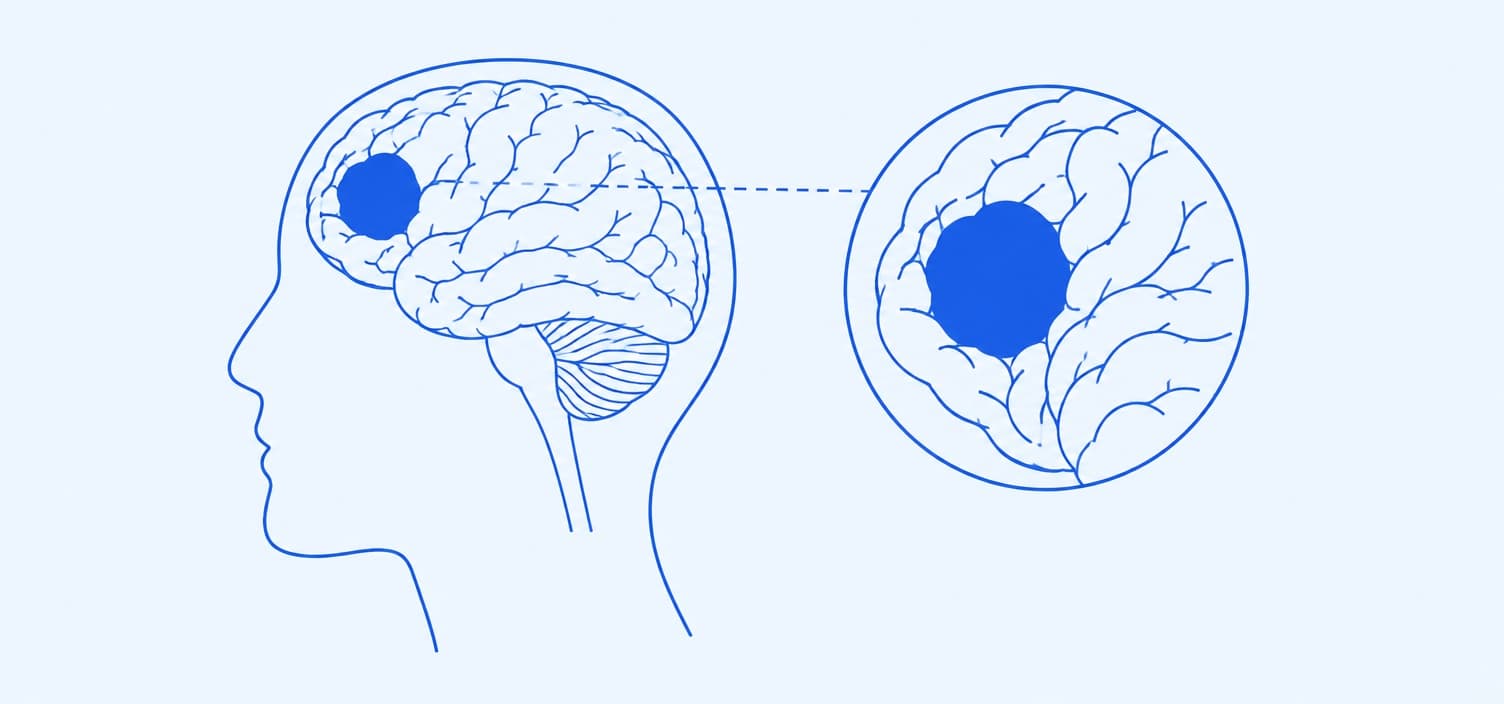
Brain tumour diagram showing a rounded tumour in the front of the brain pressing on the surrounding tissue
A brain tumour in the frontal lobe: as it grows, it pushes on the healthy brain around it, which is what causes most symptoms.

Most people hear "brain tumour" and picture the worst possible outcome, but here's what a neurosurgeon actually checks first: not whether it's there, but what kind of cells it might be made of. It forms when cells in or around the brain start dividing faster than they should, crowding space the brain needs. Where it sits and how fast it grows matter more than the word itself, and that's the part most people never get explained to them.

Brain tumours can appear at any age, in children and adults alike. Many patients arrive expecting to hear "surgery" right away; often, especially with small or slow-growing tumours, the plan starts with watching and rescanning instead. Not every one needs surgery.

Types

Types of Brain Tumour

Your scan report will usually name one of these five types. Some are benign and slow-growing, others malignant, and knowing which you have shapes every decision after.

Meningioma

The most common primary brain tumour, making up roughly a third of all primary brain tumours. Usually slow-growing.

Glioma

Arises from the brain's supportive glial cells and ranges from slow-growing to aggressive. Glioblastoma, its most severe form, grows and spreads quickly.

Pituitary Tumour

Develops in the pituitary gland at the base of the brain, often affecting hormone levels before it causes any noticeable neurological symptoms.

Schwannoma

A slow-growing tumour arising from a nerve sheath, most often the nerve responsible for hearing or facial sensation (acoustic neuroma).

Metastatic Tumour

Cancer that has spread to the brain from another part of the body, such as the lung or breast, more common in adults than a primary tumour.

Symptoms

Signs of a Brain Tumour to Recognise

  • PERSISTENT HEADACHES

    Headaches that are new, worse in the morning, or that wake you from sleep can signal rising pressure inside the skull from a growing tumour.

  • SEIZURES

    A seizure with no prior history, especially in an adult, is one of the more common first signs of a brain tumour.

  • WEAKNESS OR NUMBNESS

    Weakness or numbness on one side of the body develops as a tumour presses on the part of the brain controlling movement or sensation.

  • MEMORY OR THINKING CHANGES

    Trouble concentrating, confusion, or noticeable memory changes can appear gradually as a tumour affects the frontal or temporal lobes.

  • VISION OR BALANCE CHANGES

    Blurred or double vision, or a sudden loss of balance, often points to a tumour affecting the brain's visual pathways or the cerebellum.

When To Worry

Most Brain Tumour Symptoms Aren't An Emergency

A single headache or a moment of forgetfulness rarely means a tumour. Most people with these symptoms have something far more common, like tension headaches or stress. What matters is how symptoms behave over time, not any one episode.

Seek Immediate Care If You Also Have:

Causes

Brain Tumour Causes

  1. 01

    Unknown Cell Mutation

    Most brain tumours start with a random mutation in a single cell's DNA, with no clear trigger doctors can point to in most cases.

  2. 02

    Inherited Genetic Syndromes

    Conditions like neurofibromatosis or Li-Fraumeni syndrome run in certain families and can raise the lifetime risk of developing specific tumour types quite significantly.

  3. 03

    Prior Radiation Exposure

    Radiation treatment to the head, even years earlier for an unrelated condition, is a known and well-documented risk factor for tumour growth.

  4. 04

    Cancer Spreading From Elsewhere

    A tumour that started in the lung, breast, or skin can travel through the bloodstream and settle in the brain as a secondary growth.

Who's More Likely To Get A Brain Tumour

  • AGE

    Risk generally rises with age, though certain types, like medulloblastoma, are actually more common in children.

  • GENETIC SYNDROMES

    A family history of neurofibromatosis or similar inherited conditions raises the risk of developing specific tumour types.

  • RADIATION EXPOSURE

    Previous radiation therapy to the head or neck, even decades earlier, measurably increases long-term risk.

  • WEAKENED IMMUNITY

    A suppressed immune system, from illness or long-term medication, raises the risk of certain rarer tumour types.

Diagnosis

Brain Tumour Diagnosis

  1. 01

    Neurological Exam

    Dr. Sunkara checks vision, coordination, reflexes, and mental status to map which part of the brain might be affected, before any scan confirms what's actually there.

  2. 02

    MRI With Contrast

    An MRI scan, usually with a contrast dye, is the key test that shows a tumour's size, location, and how it's affecting the surrounding brain tissue.

  3. 03

    Biopsy & Grading

    A tissue sample, taken during surgery or a separate biopsy, is examined under a microscope to grade the tumour from 1 to 4 and guide treatment.

Treatment

How Brain Tumours Are Treated

Surgery is usually the first step here, not the last resort it is elsewhere, and it's rarely as frightening as people expect.

  • WATCH AND SCAN

    is often enough for small, slow-growing tumours, with regular MRIs tracking any change over time.

  • SURGERY

    is the usual first move for tumours that are accessible and causing symptoms, removing as much as safely possible.

  • ADDED THERAPY

    follows surgery for tumours that are aggressive or can't be fully removed, using radiation or medication on what's left.

Treatment Options Dr. Sunkara Offers

  1. 01

    Active Surveillance

    NON-SURGICAL

    Small, symptom-free, slow-growing tumours are sometimes simply monitored with scheduled MRIs rather than treated right away.

  2. 02

    Brain Tumour Surgery

    SURGICAL

    Removes as much of the tumour as safely possible, often the first step for tumours causing symptoms or pressure inside the skull.

    See Brain Tumor Surgery →
  3. 03

    Stereotactic Radiosurgery

    NON-SURGICAL

    Delivers precisely focused radiation to a tumour without an incision, often used when a tumour is small or hard to reach surgically.

    See Stereotactic Radiosurgery →
  4. 04

    Pituitary Tumour Surgery

    SURGICAL

    Removes a tumour from the pituitary gland at the base of the brain, most often through the nose rather than through an opening in the skull.

Outlook

Is A Brain Tumour Curable?

It depends almost entirely on the type and grade, so there's no single honest answer that fits every patient. Many benign, low-grade tumours are effectively cured with surgery alone. Higher-grade tumours are usually managed as a long-term condition instead.

  • TYPE AND GRADE

    shape the outlook most, alongside where the tumour sits, which is why the biopsy result matters more than a first look at the scan.

  • WATCH AND SCAN FIRST

    is often enough for small, slow-growing tumours such as many meningiomas, some of which never need surgery at all.

  • IF IGNORED

    a tumour left unmonitored can keep growing and raise pressure inside the skull, narrowing treatment options as it does.

Living With It

Living With a Brain Tumour

Life continues after a diagnosis, and daily habits shape how well it goes.

Dr. Raveesh Sunkara at his consultation desk, talking a patient through their condition
Before Your Appointment

Questions To Ask Your Doctor

  1. 01

    What type and grade of brain tumour do I actually have?

  2. 02

    Is surgery necessary now, or can we watch and scan first?

  3. 03

    What are the risks of the specific surgery you're recommending?

  4. 04

    Will I need radiation or chemotherapy after surgery, and why?

  5. 05

    How often will follow-up scans happen, and for how long?

Already Been Told You Need Surgery?

A second opinion on your scans can confirm the plan before you commit to it.

TESTIMONIALS

Trusted By Families Across India And Abroad.

★★★★★

Review summary

His mother had surgery for a meningioma and is now doing well. He credits Dr. Sunkara's guidance, skill and complete transparency at every step.

Srinu O.

Meningioma surgery

★★★★★

Review summary

Had a craniotomy for a brain tumour. The risks and recovery were explained in detail, Dr. Sunkara checked in every day, and his cognitive function has improved since.

Siva S.

Brain tumour craniotomy

★★★★★

Review summary

His wife had hand tremors, memory problems and could no longer walk. An MRI found a tumour, and Dr. Sunkara explained the problem and advised prompt surgery.

Sambasiva Rao L.

Brain tumour surgery

FAQ

Your Brain Tumour Questions, Answered

A brain tumour is an abnormal growth of cells in or around the brain, either starting there or spreading from cancer elsewhere. Not every brain tumour is cancerous.

Get In Touch

Just Been Told You Have a Brain Tumour?

Book a consultation with Dr. Sunkara to discuss your scan, or start with a second opinion if surgery has already been recommended elsewhere.

Dr. Raveesh Sunkara

Written & reviewed by Dr. Raveesh Sunkara, Senior Consultant Neurosurgeon & Spine Surgeon · Last updated September 2026 · Next review due March 2027